

You ordered a strap that looked right in the photo. The colour matched, the clasp looked tidy, and then the lugs wouldn't lock, or the band sat so loose the watch spun every time you raised your arm.
That miss is a fit problem, not a taste problem. Apple Watch straps only work when the case-size family, your wrist in millimetres, and the way the material behaves in heat, sweat and water all agree. Style is the last decision, not the first.
Table of Contents
- Why Apple Watch Straps Need More Than a Style Pick
- Which Strap Sizes Fit Each Apple Watch Case
- Measure Your Wrist and Check Fit All Day
- Replacement Straps From Nothing But Bands for Workouts and Weekends
- Materials and How They Handle Water, Sweat and Heat
- Cleaning, Drying and Skin Irritation Fixes
- Strap Lifespan, Replacement and Recycling in Australia
- Confirm Your Strap Choice Before You Buy
Why Apple Watch Straps Need More Than a Style Pick
Plenty of buyers treat the band as the last click after the watch is chosen. The listing says it fits an Apple Watch, the photo does the selling, and the order goes through. Then the connectors don't match, or the band gapes on a slim wrist.
Fit is decided in a fixed order. The case-size family comes first, because the lugs only match one group of cases. Wrist circumference in millimetres comes next, because the holes and the stretch only cover a stated span. Material comes last. Rubber and silicone move with sweat and heat. Textile and untreated metal do not belong in the surf.
The band was never an afterthought. The case and the strap were sold as a pair from the start, so a new strap can restyle the same watch for work, training or the weekend without a new device.
Look up the case group, measure the wrist, then match the material to water and heat. After that, check how the fit shifts across a warm day, how you clean it, and when irritation means you stop. By the close you can choose a strap that fits the case, the wrist and the activity, and you'll know when to take one off.
Which Strap Sizes Fit Each Apple Watch Case
Match the case group before you match a colour. Apple's Australian band specifications group straps for 38 mm, 40 mm, 41 mm and 42 mm cases as cross-compatible, and treat 44 mm, 45 mm, 46 mm and 49 mm cases, including the Ultra line, as a separate group. On that listing, a Sport Band S/M fits wrists of about 130–180 mm, and M/L fits about 150–200 mm.
| Case-size group | Strap families | Wrist fit (mm) | Cross-fit rule |
|---|---|---|---|
| 38, 40, 41 and 42 mm | Sport and leather bands sized for this group | Sport Band S/M about 130–180; M/L about 150–200 | Straps cross-fit within this group only |
| 44, 45, 46 and 49 mm | Sport and Ultra-line bands sized for this group | Sport Band S/M about 130–180; M/L about 150–200 | Separate group; confirm the case range before buying |
| 44–49 mm, Ultra line | Ocean Band | 130–200 | Specified for the larger group; tubular design for wetsuit use |
Why the Series name is not enough
A Series number does not tell you which lug you have. Someone moving from a standard case to a 49 mm Ultra is changing groups, not just buying a tougher watch. A strap that locked onto the old case can refuse the new one, even when both watches feel familiar in the hand.
The two Sport Band lengths overlap from 150–180 mm. In that band, both S/M and M/L can work. Choose by how the strap sits on your wrist, not by which Series you own. Below 150 mm, start with S/M. Above 180 mm, start with M/L.
Listings that cause returns
A product title that only says "Apple Watch compatible" is a fit risk. It skips the nominal strap size and the case range, which is exactly how the wrong lugs get posted. If the page doesn't name both, treat it as incomplete.
Confirm the case from the original box, the receipt or the order confirmation. Memory of the model name is the usual slip, especially when a household has two watches. The Ocean Band row above is for the larger group only. Don't assume a smaller-case sport strap will stretch across to an Ultra.
Measure Your Wrist and Check Fit All Day
Start with the case, then the tape. Guessing from how the current band feels is how people reorder the same loose fit.
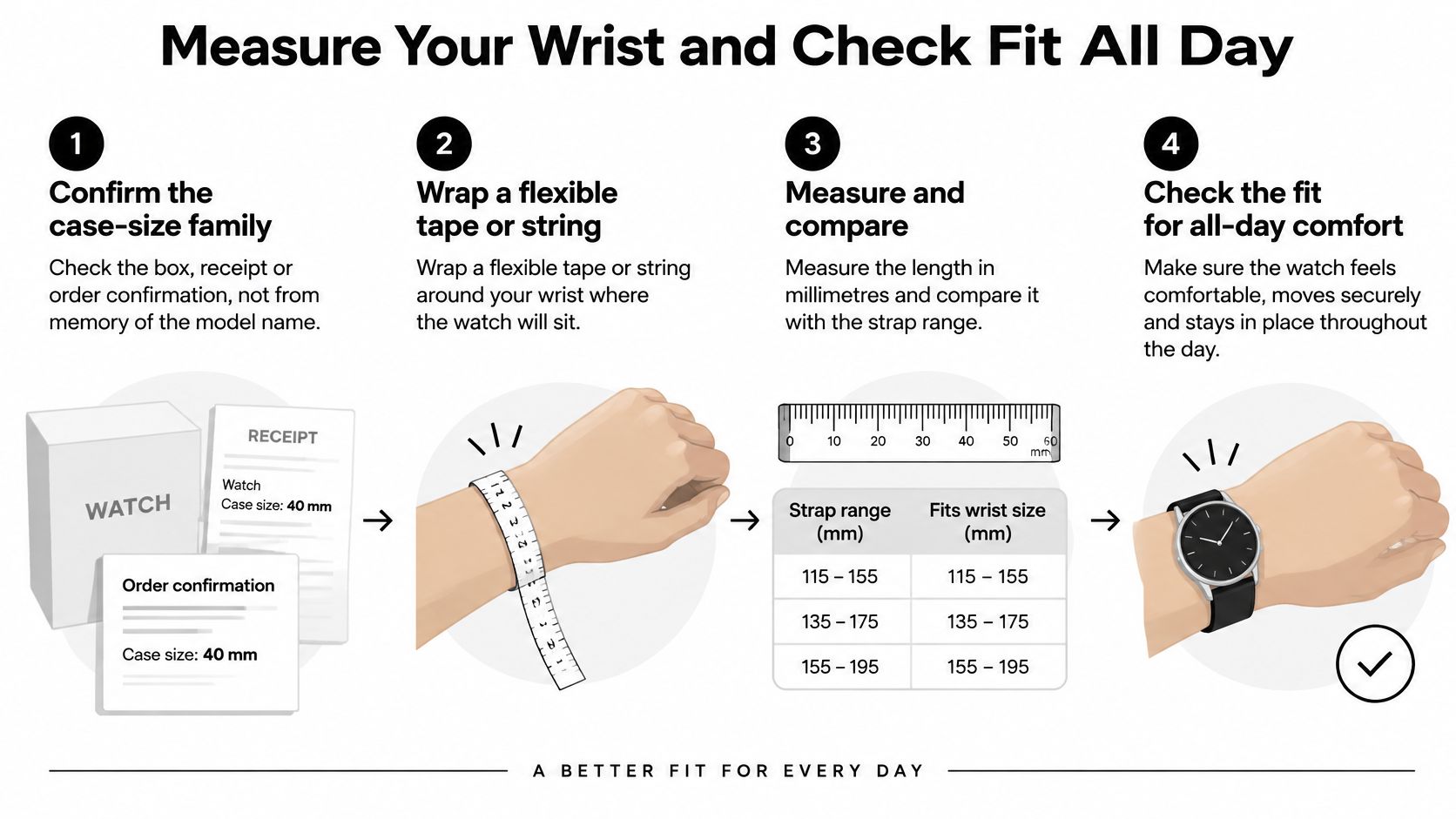
The measuring routine
- Confirm the case-size family from the box, the receipt or the order confirmation. The usual mistake is trusting the model name you remember. Two watches in one drawer often get swapped in that memory.
- Wrap a flexible tape, or a piece of string you then measure, where the watch normally sits, just above the wrist bone. Measuring over a sleeve, or with the wrist cocked differently from how you wear it, adds millimetres you don't have.
- Read the length in millimetres. Listed ranges use millimetres, so a centimetre guess rounded up will push you into the wrong length. Compare the reading with S/M at about 130–180 mm and M/L at about 150–200 mm. A reading of 150–180 mm sits in the overlap, so the deciding factor is how the strap lies, not the Series.
- Release the current strap with its button or slide, seat the new one until it clicks, and fasten it so the watch doesn't travel. You should still slide a fingertip under the band. Forcing the last hole because the photo looked snug is how pressure marks start.
- Wear it for a few hours. Check again after a warm walk and again in the evening. Wrists swell in heat, after exercise and after time in salt water. Over a long sleeve or a jacket the case sits higher and the same hole feels looser.
Practical rule: Buy enough adjustment to cover a swollen afternoon wrist and the layers you actually wear, not just a cool morning measurement at the kitchen bench.
The pass test
Too tight leaves a pressure mark that should fade within about an hour. Too loose lets the case rotate, and heart-rate or workout readings get less steady because the sensors lose even contact.
Adjust with the spare hole. Don't crank past comfort to chase a number on a listing. The strap passes when it stays put as you raise and lower the arm and leaves no pinch line. If it only behaves while you stand still, it isn't finished.
Replacement Straps From Nothing But Bands for Workouts and Weekends
A gym session and a dinner ask different things from the same watch. Silicone soaked through at 6 am sits clammy against a desk by 9. A steel bracelet that looks right at dinner heats up on a long run, holds sweat under the links, and leaves pressure marks where the metal can't flex.
Apple Watch straps from Nothing But Bands are built as swap pieces for exactly that split day. The range covers replacement bands for Apple Watch alongside Samsung Galaxy Watch, Garmin, and Fitbit, plus brands such as Fossil, COROS, and Amazfit, among others. The part that matters for fit is the material spread: genuine leather, Milanese stainless steel, soft-touch silicone, breathable nylon loops and resin links, so a workout band and a weekend band can live on one watch body.
What is worth using, and what is not
Silicone or a soft sport style, such as the Halo Silicone Sport Band, is the right call for training, humid commutes and beach days because it flexes and rinses. Nylon loops suit long dry wear when airflow matters more than water performance. Leather, Milanese or resin links, such as the Lunor Magnetic Milanese, belong in offices and evenings, kept out of the pool. None of these choices fix a wrong case group. If a listing doesn't name your millimetre family, the polished photo doesn't matter. Skip it.
Many pieces are ready to ship, and email and phone support are there if a connector arrives and doesn't match what the box says.
I would start here when you want two or three looks without hunting random marketplaces, and when you can name your case size before anything hits the cart. If you only need one dry-day band and your original already fits, another purchase won't improve the sensors.
Materials and How They Handle Water, Sweat and Heat
Material decides whether a correctly sized strap still fails by mid-afternoon. Heat, salt and sweat change how a band grips, and a closure that looks tough on a product page can be the weak point in the surf.
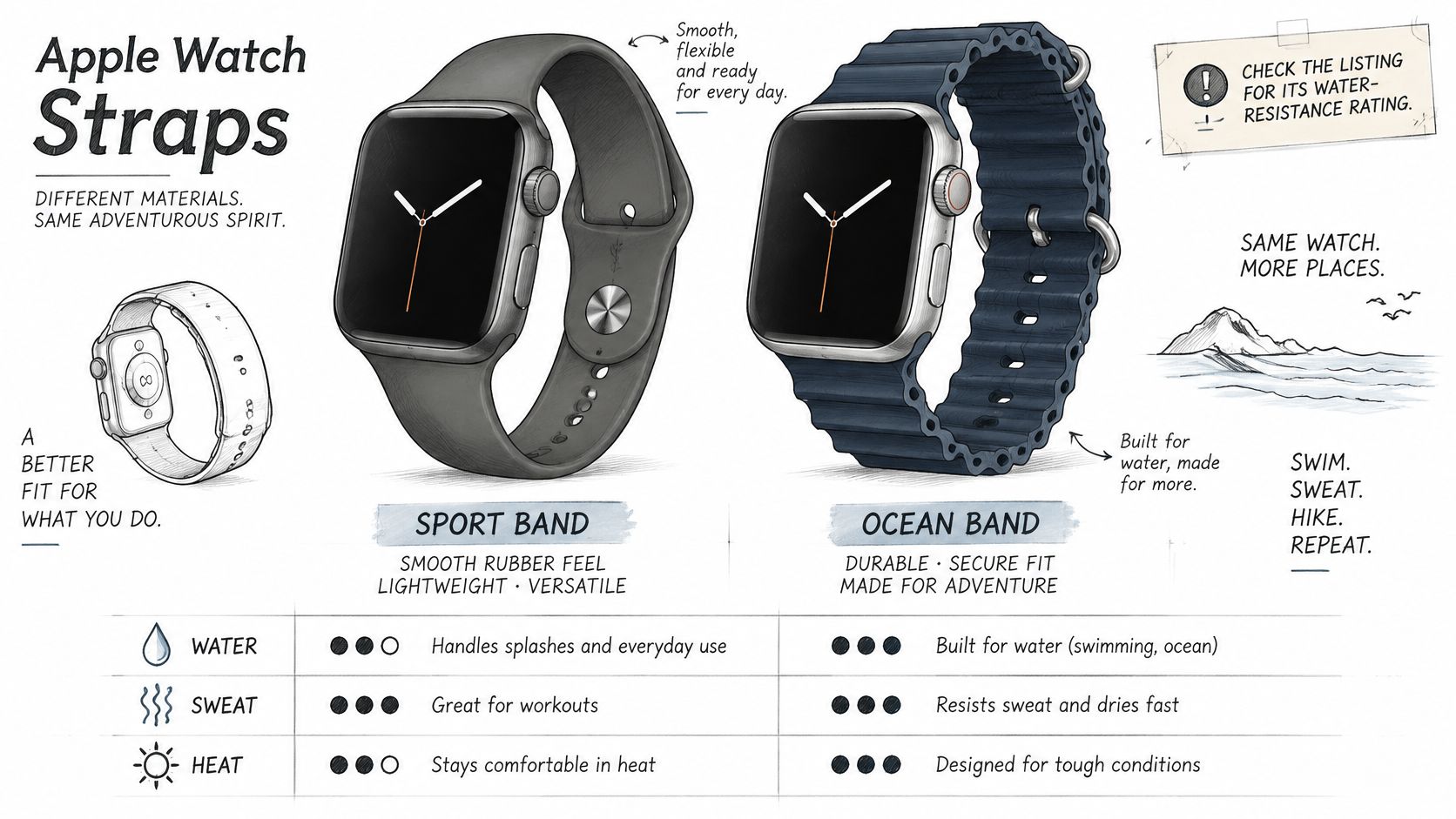
Apple's Sport Band product page identifies the Sport Band material as rubber. The Ocean Band is a different brief altogether: high-performance silicone moulded in a tubular geometry that stretches for fit, including over a wetsuit, on a corrosion-resistant titanium buckle, sized for wrists of 130–200 mm. Treat those as two separate purchases. A rubber sport strap handles sweat and a rinse; the Ocean Band is the one built around the water.
What each design is doing
Silicone's elasticity keeps the case in contact while you move and while you are wet. The tubular shape has room to expand over a rashie or a wetsuit, so you are not buying a second size for the beach. A corrosion-resistant titanium buckle copes with repeated salt better than untreated metal, which is why a fashion bracelet and a surf strap do different jobs.
The same Apple listings mark FineWoven Magnetic Link, the Modern Buckle and the stainless-steel bands as not water-resistant. Those belong to dry, low-exposure days. Pool chlorine, sunscreen and a sweaty commute will shorten them and leave the skin damp underneath.
| Material or band | Water and sweat | Stretch and fit | Upkeep |
|---|---|---|---|
| Sport Band (rubber) | Handles sweat and a rinse; not a water-sport build | Standard sizing in S/M and M/L | Rinse after sweat; dry before wearing again |
| Ocean Band (high-performance silicone) | Designed for water, including wetsuit use | Tubular, stretches over clothing and wetsuits | Rinse after salt water; dry fully |
| Stainless-steel and Modern Buckle bands | Listed as not water-resistant | Fixed or buckle adjustment | Keep dry; wipe after sweat |
| FineWoven Magnetic Link | Listed as not water-resistant | Magnetic closure; adjusts along the strap | Keep dry; avoid prolonged moisture |
For swimming, surfing or heavy sweating, use silicone or an Ocean-style strap. Keep textile and metal for the office and the evening. Rinsing without drying only moves the moisture into the next wear, and a band that gripped perfectly on a dry morning can sit looser once it is wet, so recheck the fit after a swim rather than trusting the notch you picked at breakfast.
Cleaning, Drying and Skin Irritation Fixes
A water-resistant label is not a comfort guarantee. Fit, drying time, soap left in the band and hours of continuous wear matter as much as the material name. "Hypoallergenic" on a box doesn't override a strap that stays wet against the skin from the beach to a cold office.
Apple's safety guidance says irritation can come from nickel, acrylates or methacrylates, from prolonged sweat or soap, and from a band worn too tightly or too loosely. It also says to keep the watch and band clean and dry, take the watch off now and then so skin can breathe, and stop if redness, swelling or itching shows up.
A routine that matches Australian days
- Rinse after exposure: After sweat, the pool or the sea, rinse the strap under fresh water before it dries salty.
- Wash on heavy days: Use mild soap and water after long sessions, and more often in humid weather. In a sticky week, that can mean most evenings, not once a fortnight.
- Clear the soap: Rinse until the band doesn't feel slippery. Residue trapped under a tight hole is a common itch that people blame on the rubber.
- Dry both surfaces: Dry the strap and the wrist fully before it goes back on. A damp patch under a "waterproof" band is still a damp patch.
- Rotate two straps: Let each one dry completely between wears. Taking the watch off at your desk gives the skin a break the band cannot provide on its own.
Irritation risk climbs when sweat or soap stays in contact for hours. Rotating straps separates a dirty band from a sensitive patch of skin, which a single favourite strap never does.
| Symptom | Likely cause | First action |
|---|---|---|
| Redness, itching or swelling under the strap | Possible sensitivity to nickel, acrylates or methacrylates, or trapped moisture | Remove the strap, clean and dry the skin; stop use and see a doctor if it persists |
| Pressure marks or rash only where the strap is tight | Strap too tight or friction from movement | Loosen one hole and rest the wrist; recheck after a few hours |
| Damp patch or sour odour | Sweat and soap residue kept against the skin | Wash the strap with mild soap, rinse and dry fully before wearing |
If redness, swelling or itching continues after the band is off, clean and dry, stop wearing it and get medical advice. Swapping to another colour of the same material is not a treatment.
A mark that fades after you loosen one hole is friction or pressure. A rash that returns on a dry, correctly fitted strap is a reason to stop, not to shop.
Strap Lifespan, Replacement and Recycling in Australia
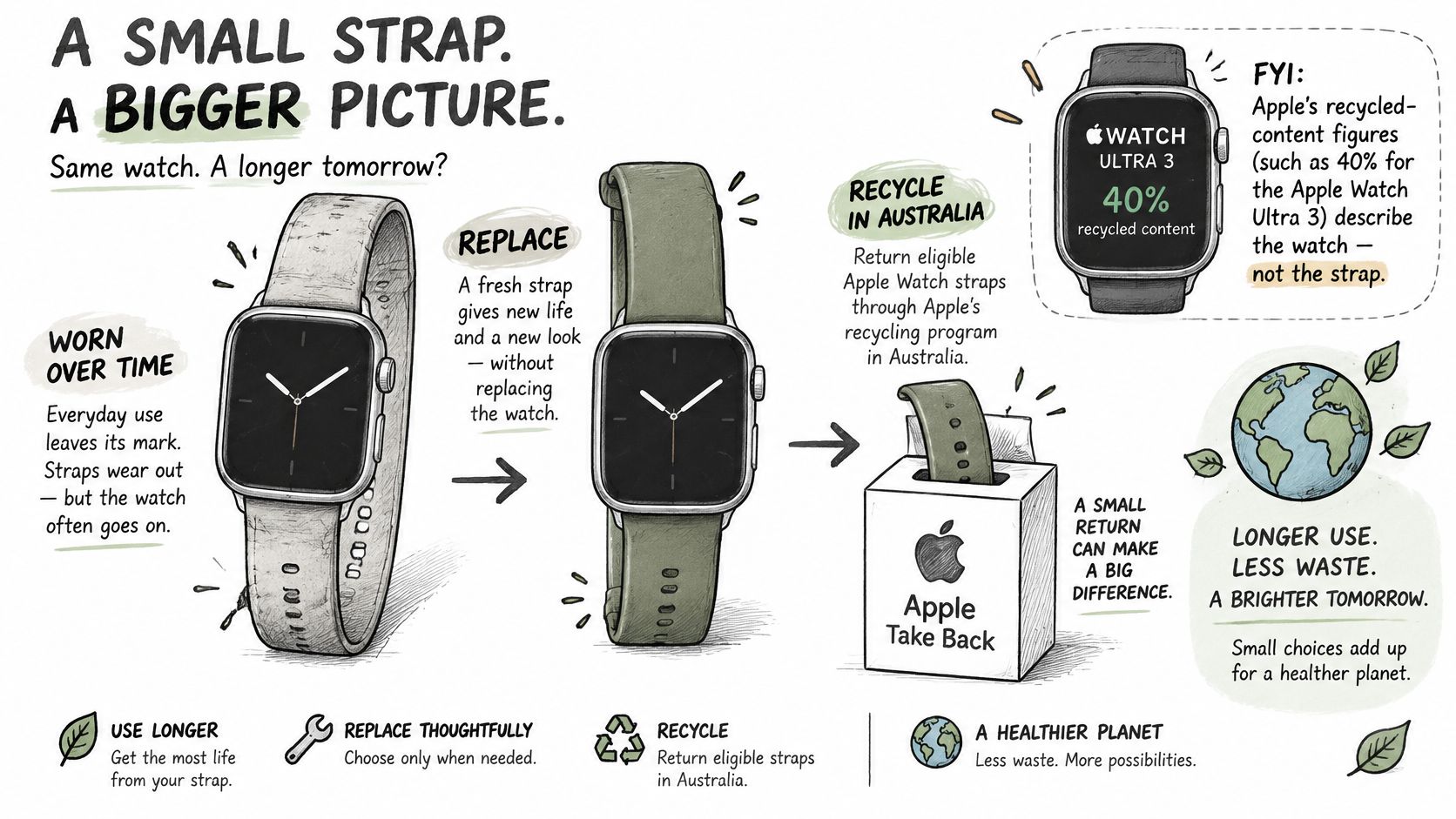
A recycled-content badge on a watch is not a green strap. Apple says the Apple Watch Ultra 3 contains 40% recycled content, and that its titanium case uses a 3D-printing process needing half the raw material of earlier generations, in the Ultra 3 announcement. Those figures describe the watch, not the band clipped to it. A strap can carry recycled content and still be a poor lifecycle buy if it cracks in a season or can't be separated and recycled where you live.
When replacement beats another rinse
Sweat, sunscreen, salt water and Australian summer sun all shorten a strap's useful life. A worn band also stops doing its fit job: a stretched loop lets the case wander, so the watch sits loose on skin it was sized to grip. Check for these four signs:
- Cracked or stiff silicone: Flex is gone, so the band saws at the skin instead of moving with it.
- Stretched or split loops: The hole you trusted no longer holds the same wrist.
- A clasp or buckle that slips: If it opens when you shake your wrist, the strap has finished its job.
- Odour or residue that washing doesn't clear: That's material breakdown, not a missed rinse.
Several cheap straps can cost more in waste than one band that survives salt, sunscreen and UV. I would rather wear one durable sport strap for wet days and keep a single dry-day band aside than cycle through three lookalikes that stiffen by summer.
What to do with the old one
Gift or resell a strap that still locks and still smells clean. For the rest, check your council's rules for textile, silicone and metal. Acceptance isn't the same from one area to the next, and a household recycling bin is not a guarantee. A mixed band, metal buckle on a textile tail, often can't go through as one piece, so separate the parts where the hardware allows it. If you can't tell whether your council takes it, ask them rather than guessing from the recycling symbol on the packet.
Confirm Your Strap Choice Before You Buy
A strap earns its place only if the case family, wrist measurement and material all line up; style comes after those three. Water, sweat and heat expose a bad match faster than a mirror does. Five checks before you pay will save the return that starts with "it doesn't clip".
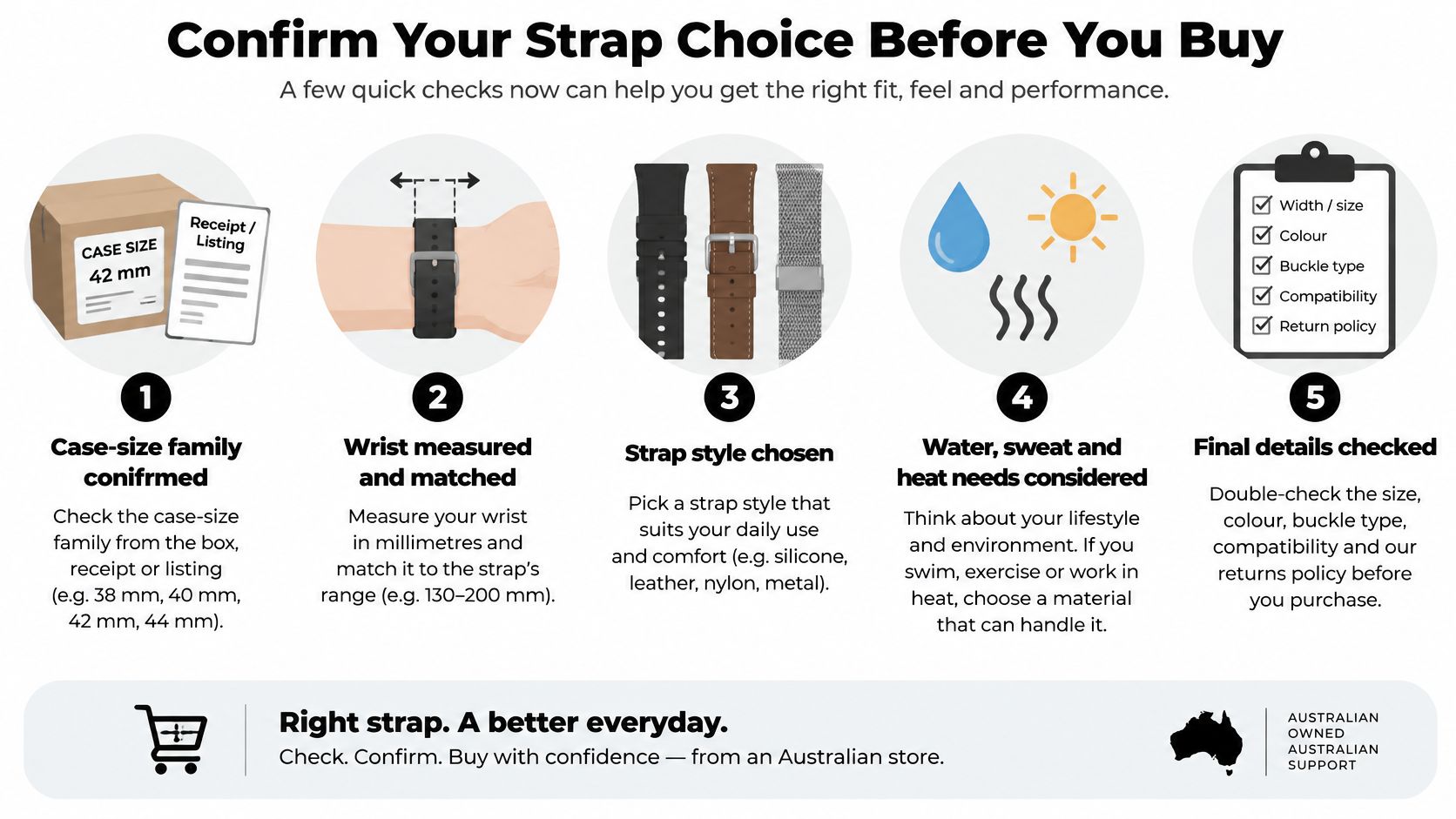
- Confirm the case-size family from the box, the receipt or the listing, not from the Series you think you bought.
- Measure the wrist in millimetres and fall inside that strap's range. Sport Band S/M is about 130 to 180 mm, M/L about 150 to 200 mm, and the Ocean Band 130 to 200 mm on the larger case group.
- Match material to the main activity. Silicone or an Ocean-style strap for swimming, surfing and heavy sweat. Textile and metal only for dry wear.
- Read the listing for the nominal strap size and compatible case range, plus a water-resistance rating where one applies. "Apple Watch compatible" on its own is not that statement.
- Know the return or exchange window before checkout, including how many days you have once it arrives.
The home try-on
Order it, then wear it for a day or two. Heat changes the test: check after a warm walk and again in the evening, because a wrist that measures inside the range at breakfast can sit differently once it warms up. Keep the packaging until the fit is confirmed. A strap that only feels right for the first ten minutes at the door often slips later.
If it rubs, pinches or slips, exchange it inside the return window. Forcing an extra hole, or wearing it loose so the case spins, doesn't become a fit with time.
The signs stay specific: a pinch line, a wandering case, a band that only works over one particular sleeve. Send it back while the window is open. A second colour of the wrong group will fail the same way.


